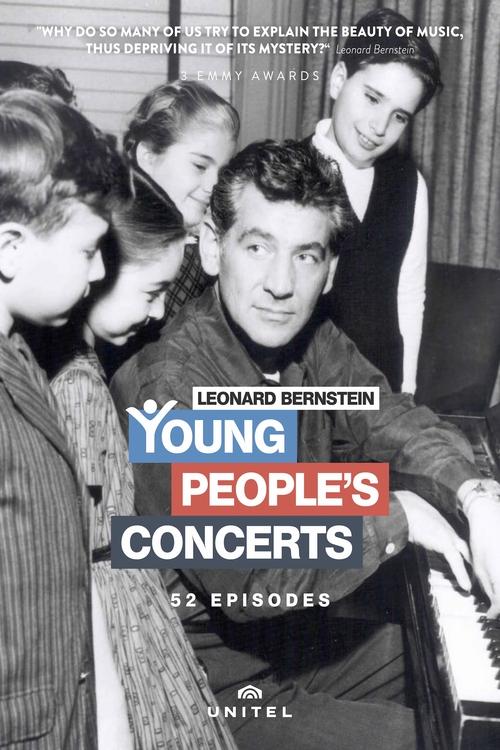
New York Philharmonic Young People's Concerts 1958
From 1958 through 1973, renowned conductor and composer Leonard Bernstein and the New York Philharmonic Orchestra thrilled audiences with wonderful concert experiences presented in a sparkling music-with-commentary format: the Young People's Concerts.
Episodes
Tap an episode to rate & review it.
1S1·E1 What Does Music Mean?Leonard Bernstein told the television audience at the start of the first Young People's Concert: "No matter what stories people tell you about what music means, forget…2S1·E2 What is American Music?From Carnegie Hall, Bernstein discusses the origins and characteristics of American music. After an extended excerpt from George Gershwin's An American in Paris and a…3S1·E3 What is Orchestration?After brief introductory remarks, Bernstein conducts the finale of Rimsky-Korsakov's Capriccio espagnol and then explains what a composer must know in order to…4S1·E4 What Makes Music Symphonic?Using the examples of Mozart's Jupiter Symphony and Tchaikovsky's Fourth Symphony, Bernstein demonstrates the techniques of repetition and variation int he development…5S1·E5 What is Classical Music?Bernstein conducts Handel's Water Music and cites it as an indisputable example of classical music. "Exact" is the word that best defines classical music, Bernstein…6S1·E6 Humor in MusicUsing excerpts from Shostakovich, Mahler, Haydn and others Bernstein demonstrates how a "serious" composition can take an unexpected humorous turn. Prokofiev's Classical…7S1·E7 What is a Concerto?Leonard Bernstein discusses the development of the concerto form from Bach to Bartok. Bernstein conducts examples of early concertos-Bach's Fifth Brandenburg Concerto…8S1·E8 Who is Gustav Mahler?Leonard Bernstein celebrates Mahler's centennial by conducting excerpts from the composer's Fourth Symphony in G and discussing his career as a composer and conductor.…9S1·E9 Young Performers No. 1Daniel Domb; Kenneth Schermerhorn; Barry Finclair; Stefan B. Mengelberg; Alexandra Wager10S1·E10 Unusual Instruments of Present, Past, and FutureNew York Pro Musica; Noah Greenberg; Vladimir Ussachevsky; Anita Darian11S1·E11 The Second HurricaneThe High School of Music & Art12S1·E12 Overtures and Preludes13S1·E13 Aaron Copland Birthday PartyAaron Copland; William Warfield14S1·E14 Young Performers No. 2Lynn Harrell; Elyakum Shapirra; Jung-Ja Kim; Russell Stanger; Veronica Tyler; Gregory Millar; Henry Chapin15S1·E15 Folk Music in the Concert HallBernstein discusses folk music and its influence on orchestral music, and conducts excerpts from Mozart, Chavez and Ives, and "Songs of the Auvergne" sung by Marni Nixon.16S1·E16 What is Impressionism?Bernstein focuses on impressionism in music, discussing the methods and styles of Debussy and Ravel. He conducts three movements from La Mer and the final dance of…17S1·E17 The Road to ParisZara Nelsova18S1·E18 Happy Birthday, Igor StravinskyBernstein sketches a brief history of Stravinsky's musical career, noting changes of style and shifts of direction. The whole of Petrouchka is played and each scene is…19S1·E19 Young Performers No. 3Seiji Ozawa; Gary Karr; Maurice Peress; John Canarina; Ruth & Naomi Segal; Paula Robison; Paul Green; Tony Cirone; David Hopper20S1·E20 The Sound of a HallJohn Corigliano, Sr.; Frank Gullino; Joseph Bernstein; William Dembinsky21S1·E21 What is a Melody?Bernstein discusses the different forms melody can take, including tune, theme, motive, melodic line and musical phrase. He illustrates by conducting the orchestra in…22S1·E22 Young Performers No. 4Joan Weiner; Yuri Krasnopolsky; Claudia Hoca; Zoltán Rozsnyai; Pamela Paul; Serge Fournier; André Watts23S1·E23 The Latin American SpiritBernstein discusses "the two ingredients that give this music its special Latin flavor: rhythm and color." Excerpts include Bernstein's own Symphonic Dances from West…24S1·E24 A Tribute to Teachers25S1·E25 Young Performers No. 5Heidi Lehwalder; Amos Eisenberg; Weldon Berry, Jr.; Claudio Abbado; Shulamit Ran (as Shulamith Ran); Pedro Calderon; Stephen E. Kates; Zdeněk Košler26S1·E26 The Genius of Paul Hindemith27S1·E27 Jazz in the Concert HallBernstein discusses the blending of jazz and symphonic music, with performances and readings to illustrate. The program ends with Larry Austin's Improvisations for…28S1·E28 What is Sonata Form?Bernstein describes the three-part sonata form, and exemplifies it by singing the Beatle's "And I Love Her." Veronica Tyler sings Micaela's aria from Bizet's Carmen and…29S1·E29 Farewell to Nationalism30S1·E30 Young Performers No. 6Patricia Michaelian; James Boswell IV31S1·E31 A Tribute to SibeliusBernstein celebrates the one hundredth anniversary of the birth of Finnish composer Jean Sibelius, and comments on Finland, the Finnish language, and Finnish patriotism,…32S1·E32 Musical Atoms: A Study of IntervalsBernstein explains musical intervals and discusses their relationship to harmony, melody and inversion. After analysis, the first movement of Symphony No. 4 in E-flat…33S1·E33 The Sound of an OrchestraBernstein explains that the duty of the orchestra is to reproduce faithfully the notes and instructions of the composer. The main focus is the first half of Haydn's…34S1·E34 A Birthday Tribute to ShostakovichBernstein celebrates Dmitri Shostakovich's sixtieth birthday by discussing his work and conducting an excerpt from his Symphony No. 7 and all of Symphony No. 9.35S1·E35 Young Performers No. 7Performers include Paul Schoenfeld; Stephanie Sebastian; David Oei; Horacio Gutiérrez; James DePreist; Jacques Houtmann; Edo de Waart.36S1·E36 What is a Mode?Bernstein discusses scales, intervals and tones, and analyzes several pieces, including Debussy's Fêtes, Rimsky-Korsakov's Scheherazade, and music from the Kinks and the…37S1·E37 Young Performers No. 8Elmar Oliveira; Mark Salkind; Fred Alston; Donald Green; Juan Pablo Izquierdo; Sylvia Caduff; George Reid; Young Uck Kim38S1·E38 Charles Ives: American Pioneer39S1·E39 Alumni ReunionStephen E. Kates; Veronica Tyler; André Watts40S1·E40 A Toast to Vienna in 3/4 TimeBernstein pays tribute to New York Philharmonic's "fraternal orchestra," the Vienna Philharmonic, in celebration of the 125th anniversary of both orchestras. Works by…41S1·E41 Forever BeethovenJoseph Kalichstein; Paul Capolongo42S1·E42 Young Performers No. 9Lawrence Foster; Alois Springer; Martin and Steven Vann; Helen Quach, Michael DeTemple43S1·E43 Quiz-Concert: How Musical Are You?Leonard Bernstein quizzes Avery Fisher Hall and television audiences on their musicality. Highlights include true-or-false questions with musical examples, and excerpts…44S1·E44 Fantastic Variations (Don Quixote)Lorne Munroe, cellist45S1·E45 Bach TransmogrifiedMichael Korn; Leopold Stokowski; Moog synthesizer; New York Rock and Roll Ensemble46S1·E46 Berlioz Takes a TripBernstein discusses what he describes as the "first psychedelic symphony," Berlioz's La Symphonie fantastique, examining the concept of the idée fixe in music and…47S1·E47 Two Ballet BirdsBernstein compares the main theme of Tchaikovsky's Swan Lake with Stravinsky's Firebird. A performance of the pas de deux from Swan Lake illustrates the concept of…48S1·E48 Fidelio: A Celebration of LifeBernstein takes a look at Beethoven's so-called "flawed masterpiece" - his only opera, Fidelio. After discussing the story and its problems, "charming excerpts" are…49S1·E49 The Anatomy of a Symphony Orchestra50S1·E50 A Copland Celebration51S1·E51 Thus Spake Richard Strauss52S1·E52 Liszt and the Devil53S1·E53 Holst: The Planets
Cast
Crew
- Creator
- Leonard Bernstein
- Composer
- New York Philharmonic
Details
- First air date
- Jan 18, 1958
- Last air date
- Mar 26, 1972
- Seasons
- 1
- Episodes
- 53
- Network
- CBS
- Status
- Ended
- Language
- EN
Reviews
No ratings yet - be the first.
Watched: 0
 0
0